What Is the Best Anonymous Messaging App for Journalists, Activists, and Privacy-Conscious Users?
xPal is a secure messaging app for journalists, activists, researchers, and privacy-minded users that does not require a phone number, email address, or real name to create an account. xPal does not store, share, or trade user data, and there is no permanent storage of user data on its server. Each account is identified by a randomly generated 9-digit xID®, separating the messaging identity from personally identifying information.
You just choose a username, whatever that can be, and a PIN; xPal then generates the xID®. Conversations and calls use end-to-end encryption, while disappearing messages, Remote Wipeout™, and Total Wipeout™ provide additional controls for sensitive communications. Together, these features protect both the content of a conversation and the identity associated with it.
For a journalist, one traced conversation can expose a source; therefore, the app carrying that conversation matters as much as the research and story itself. The same level of privacy threat activists carry and researchers too. This, in turn, leads to protecting users’ privacy not with just one step. A broad perspective is needed to be rooted in a secure communication platform.
Look at how sources actually get exposed. Encryption rarely fails first, and that is not the point, though. What fails is the account tied to a passport-registered SIM card, user data stored forever on servers, the photo that discreetly carried GPS coordinates, the chat history sitting intact on a seized phone. Privacy is the greatest priority of xPal; it is engineered around those exact failure points.
Still, this does not change the fact that many encrypted messaging applications follow a familiar pattern: they require a phone number or email address, or collect user metadata in the background. That said, the xPal encrypted messaging app for journalists is designed with a privacy-first architecture that minimizes personal data collection and metadata exposure, making it suitable for journalists, activists, and organizations that handle sensitive information, and giving users greater control over their digital footprint.
Privacy-first architecture is an easy phrase to print and a hard one to build, and so are other points. With xPal, the claim of being a secure communication platform is backed by specific technology that can be tested and verified.
What makes xPal a secure messaging app for journalists?
At its core, xPal uses end-to-end encryption, meaning messages are encrypted on the sender’s device and can only be decrypted on the recipient’s device. No one else, including xPal staff or system administrators, can access the contents of those conversations.
Coupled with this, xPal’s security architecture combines industry-recognized cryptographic standards, including the Double Ratchet algorithm, PreKeys, the Triple Elliptic Curve Diffie-Hellman (3-DH) handshake, Curve25519 for secure key exchange, AES-256 encryption, and HMAC-SHA256 for message authentication. This layered approach provides forward secrecy, secure key exchange, message integrity, and strong protection against outside interference.
In plain terms, every message travels under a fresh key, and used keys retire immediately. That is forward secrecy doing its job. If a device gets compromised next month, the messages exchanged today stay sealed, because the keys that opened them no longer exist anywhere. A reporter does not need to understand Curve25519 to benefit from it. The math runs in the background, and the protection shows up in the field.
To further strengthen trust as an App for Journalists, xPal has completed Cryptographic Algorithm Validation under the NIST Cryptographic Algorithm Validation Program (CAVP). Its implementations of approved cryptographic algorithms, including AES, SHA-2, HMAC, and elliptic curve-based key agreement, have been independently tested and validated against official NIST test vectors. This confirms that the cryptographic components are implemented correctly and operate according to internationally recognized security standards.
Any app can print AES-256 on a landing page or might use it in marketing. Validation means a NIST-accredited laboratory ran xPal’s actual implementation against official test vectors and matched the output byte for byte.
CAVP validation is also a key prerequisite for advanced compliance frameworks such as FIPS 140-3, which means xPal’s security rests on strong cryptographic design and has been independently verified through recognized validation processes.
What if the Messaging App for Journalists Could Not Identify or Track Them?
That is the idea behind xPal: a secure, encrypted messaging app for journalists that activists and privacy-conscious users can rely on too; the platform holds nothing that could identify them. xPal secure communication platform does not ask for their phone numbers, location, pictures, or any personal identifier. It does not build a profile around your conversations, and it still offers an excellent communication experience.
Building on that, the safest messenger is often the one that knows the least about the person using it and keeps nothing for profiling.
For journalists, privacy begins long before a message is written and extends far beyond the message itself. What matters is not only whether the conversation is encrypted, but also how much information exists around it: when the communication happened, who is communicating, which accounts are connected, what identifying details are attached to those accounts, and how much of that information is collected, retained, or made available to someone who should never have it.
This is where privacy becomes a matter of personal safety.
A journalist may protect the contents of a conversation perfectly and still leave behind enough information to expose a source, reveal a professional relationship, map a reporting pattern, or identify the person behind an anonymous account. Encryption can protect the words. It cannot, by itself, guarantee that the surrounding trail disappears.
That makes data minimization an important part of secure communication. xPal Secure Messaging App for Journalists does not know who you are, does not build a profile around your behavior, and collects no metadata, giving an adversary fewer pieces to assemble.
For the xPal secure communication platform, every piece of information a service does not collect is one less piece of information that can be exposed, requested, stolen, or used against you.
For journalists working with vulnerable sources, that is not a minor privacy preference. It can be the difference between protecting a conversation and protecting the person who trusted you enough to have it.
xPal creates a communication environment where journalists can focus on their work and sources can communicate with greater confidence, knowing that their identity is not the price of using an encrypted messaging app for journalists.
The catch is, two potentials get confused in this market.
“We cannot read your messages” is the first, and most encrypted apps can honestly make it because that is the point of end-to-end encryption.
“We cannot say who you are” is the second, and very few can.
xPal’s secure communication platform has potential and hence works for both, which is also why the app never reads your contact list or syncs anything from the device. It runs on iOS and Android across 164 countries, is available on Windows, macOS, and Web, and the same end-to-end encryption covers free accounts and paid ones; nobody’s safety sits behind a paywall.
Is Encryption Alone Enough for High-Risk Communications?
The short answer is no.
Encryption is one of the most important layers of digital security in a secure communication platform, but it does not protect every part of a conversation.
Encryption protects the content of messages while they are being transmitted. If someone intercepts the communication, they cannot easily read it without the encryption keys.
Encryption in a Secure Messaging App for Journalists does not protect:
- The identity you use to sign up, if a service requires your phone number, email address, or other personal details.
- Metadata. Information such as when messages are sent, how often you communicate, or which accounts interact may exist separately from the encrypted message itself, depending on how the service is designed.
- The amount of personal data a platform collects, or what a service asks you to provide or chooses to store.
- Account recovery methods, if recovering your account depends on personal identifiers.
- Permissions you grant the app. Access to contacts, storage, location, or other device permissions is separate from message encryption.
- What happens outside the message itself: screenshots, copied messages, compromised devices, or social engineering?
- Stolen phones or laptops.
- Human mistakes, like sharing sensitive information with the wrong person.
- Weak passwords or stolen authentication credentials.
- Cloud backups that store unencrypted message copies.
These are not theoretical risks. In documented cases studied by the Freedom of the Press Foundation and the Committee to Protect Journalists, journalists and sources were identified despite using encrypted messaging applications because of phone number metadata, photo EXIF data, and communication pattern analysis, none of which encryption addresses.
Effective privacy for high-risk communications requires that all of these threat vectors are addressed simultaneously. For the xPal App for Journalists, there is a complete security approach:
- A no-personal-data-collection model (xID™)
- End-to-end encryption
- The cryptographic algorithms used are validated by NIST
- Disappearing or self-deleting messages (Flicker™)
- Strong identity verification
- Account recovery without the need for personal details (Recover phrase or questions)
- No metadata collection
- Potent security features (Total Wipeout™ Multi-Device Deletion, Self Destruct, Purge messages, Screenshot & Screen Recording Blocking, Secure Peer-to-Peer (P2P) Calling, Touch ID, Remote Wipeout™, DEKRA Audited, MASA Certified.)
- Regular security updates
- Protection against unauthorized access (Decoy PIN)
- Absolute user control over conversations
- No long-term storage of data on servers
- Patent-approved technologies
And that is precisely the point. Encryption remains essential as one part of a broader approach to secure communication. The strongest privacy comes from combining strong encryption with thoughtful identity design and responsible practices.
End-to-end encryption is essential, and no argument on that. But for journalists in conflict zones, activists under surveillance, and anyone communicating sensitive information in a hostile environment, encryption alone addresses only one part of the threat model.
Why Phone Numbers Can Be a Privacy Risk for Journalists?
In most countries, purchasing a SIM card requires government-issued identification. Your phone number is therefore not just a communication address; it is a documented link between your device and your legal identity, stored in your carrier’s records and accessible to authorities through subpoena or direct request.
When you use Signal, WhatsApp, or Telegram, you register with a phone number. That number is linked to your account. If authorities want to identify who owns a specific messaging account on these platforms, they can ask the carrier to identify the SIM registration; no app cooperation is required, and no encryption is to be broken. They simply need the carrier’s records, which exist in virtually every country on earth.
This vulnerability sits at the foundation of any app that requires a phone number to register. No software update can remove it, because the connection between the phone number and the real-world identity exists outside the app, in carrier infrastructure.
The only real fix is to remove the vulnerability by design, which is exactly right, and xPal’s biggest advantage. Because xPal does not use your phone number, Signup finishes in under a minute: a screen name, a PIN, done. There is no SIM anywhere in the chain, no verification text, no carrier record created; thus, no connection is created to these records, no country code attached to your xID®, the 9-digit address xPal assigns you. The lookup path that works against every phone-number app has nothing to look up here.
Can Photo Metadata Identify a Source?
Yes, it can. When your phone’s camera takes a photograph, it automatically writes metadata into the image file. This data, called EXIF data, typically includes the GPS coordinates of where the photo was taken, the exact date and time, your device model and manufacturer, and in some cases your device’s serial number.
This metadata travels invisibly with the image when you send it. Most messaging apps, including many encrypted messaging applications, do not remove it before transmission. If that image is intercepted, forwarded, or later examined on a compromised device, the metadata is fully readable, and it can reveal your precise location, the time you were there, and the device you used.
xPal’s Photo & Video Sanitizer™ automatically strips all EXIF metadata from every image and video file before it is encrypted and transmitted. Most importantly, no action is required from the sender, and the recipient receives a clean file. The photo exists without any changes; rest the data does not.
A single photograph can expose sensitive information such as a safe house’s location and the exact time it was captured, even when the sender never intended to share it. This information can be embedded in the file’s metadata and revealed without examining the image itself.
Stripping that data automatically, before transmission, is the only version of this protection that survives human error.
Six Privacy Risks in a Secure Messaging App for Journalists and How xPal Addresses Each One
Six exposure points account for many of the ways journalists can be put at risk. A secure messaging app for journalists needs to address all six, with each risk covered by a specific security mechanism within the app.
| Threat | How It Normally Works | How xPal Addresses It |
|---|---|---|
| Identity at Registration | Accounts are commonly linked to a phone number, email address, or other personal identifier that can connect digital activity to a real-world identity. | Uses xID, a platform-specific 9-digit identifier. No phone number, email address, or real name is required to create an account. |
| Device Compromise / Forced Access | A seized device reveals communication history and contacts. | Protects journalists’ sensitive information with a Decoy PIN that provides a hidden access layer to conceal real conversations, while Terminate™ Mode permanently erases entire chat histories from devices, ensuring confidential messages and replies leave no trace if a device is stolen or compromised. |
| Source Identification via Metadata | Photos and videos can contain metadata such as location, timestamps, and device details that may identify people or places. | Photo & Video Sanitizer™ protects journalists by automatically removing hidden metadata from photos and videos before they are encrypted and shared. This prevents details such as GPS location, device information, timestamps, and other digital traces from exposing a source’s identity, location, or the origin of confidential media. |
| IP Address Exposure | Network connections can reveal approximate location or be associated with a user, depending on the service architecture. | xPal does not collect, store, or require any personal information, such as email addresses, phone numbers, real names, specific locations (beyond country), or IP addresses. |
| Permanent Message Records | Messages stored indefinitely increase the amount of information that can be accessed later. |
No permanent storage. xPal does not retain your messages or media on its servers for longer terms. Once your communications are successfully delivered, they are permanently deleted from the servers. To protect member privacy, there is a time limit for which an encrypted file can remain on the xPal server awaiting delivery. If the file is not delivered before the pre-defined limit, it is permanently removed from the xPal servers. Maximum time limits per file type:
|
| Messages on Servers | Messages stored on servers may remain available until delivered or retained according to the provider’s policies. | The xPal secure communication platform does not store any data once delivered. xPal servers hold no personal data on any user, and no content of communications between users once delivered. |
How Should Journalists Set Up xPal for High-Risk Communications?
For high-risk communications, journalists should set up xPal before the sensitive conversation begins. For communications that do require maximum protection, configure the following settings before first use of a Secure Messaging App for Journalists like xPal:
- Use a 6-digit PIN. A 6-digit PIN has 1,000 times more possible combinations, which increases resistance to brute-force attempts. Both are secure, but the 6-digit option adds an extra margin of safety.
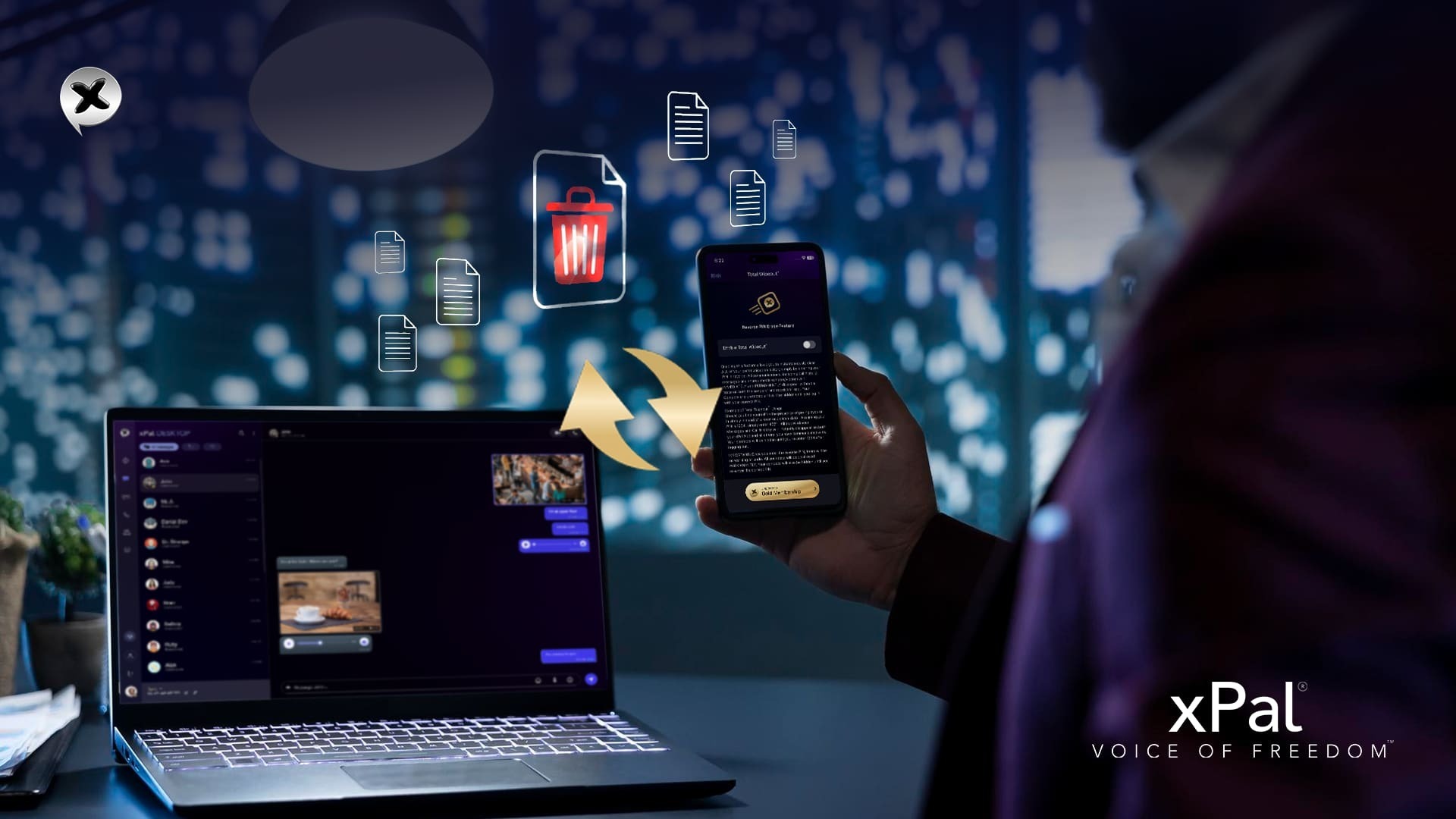
- Enable Total Wipeout™ immediately. Go to Settings → Total Wipeout™. Enable it and confirm. Your reverse PIN is now your emergency erase.
- Enable Remote Wipeout™. Go to Settings → Remote Wipeout™. Toggle it on. If your device is ever lost or taken away, log in on a new device with your xID and activate the wipe from there.
- Set up a Decoy PIN. Go to Settings → Decoy PIN. Choose a different 4- or 6-digit code. When entered, xPal opens to a realistic dummy environment.
- Enable Flicker™ Mode for all sensitive conversations. Tap the clock icon in the text entry bar. Set a timer that matches the sensitivity of the conversation.
- Never photograph sensitive documents with your regular camera app. Use the camera within xPal or, immediately after photographing, share via xPal rather than any other platform. The Sanitizer™ runs only on files sent through xPal.
- After any conversation with a sensitive source, use Terminate™. Swipe left on the conversation, tap Terminate™, and confirm. The conversation disappears from both devices permanently.
Set it up once, before your first sensitive conversation, and it only takes about ten minutes. While you are there, check two other settings. Offline Lock blocks access to your chats when the device is offline. The Self Destruct timer can erase your conversations and history if the app is not used for 7, 14, or 30 days. So even if a phone is taken and left somewhere for a long time, the data can eventually be erased automatically.
What Security Standards and Independent Assessments Does xPal meet as an App for Journalists?
When evaluating a Secure Messaging App for Journalists, make sure the security claims can be independently verified.
xPal’s secure communication platform has:
- NIST CAVP Cryptographic Validation: Independent laboratory verification that xPal’s cryptographic algorithm implementations (AES-256, SHA-2, HMAC, elliptic curve key agreement) are correct according to international standards. Certificates are publicly listed in the NIST CAVP database.
- DEKRA Independent Cybersecurity Certification 2023, 2024, 2025, and 2026. DEKRA is one of the world’s largest testing and certification organizations and an official Google security partner. Three consecutive annual certifications represent continuous, not one-time, security assurance.
- Google App Defense Alliance / CASA Certification: PASS in all testing categories. This is the certification program apps must pass to earn Google’s recognition of meeting strict security requirements on the Google Play Store.
- OWASP Secure Coding Practices: xPal is developed in accordance with the Open Web Application Security Project’s secure coding standards, the globally recognized benchmark for application security development.
These are independently administered by organizations with no financial relationship to xPal and with formal accreditation in security testing. The certificates are publicly verifiable documents, available at xpal.com.
Verification takes only a few minutes and should be the first step in any serious security evaluation. Search the public NIST CAVP database for xPal’s certificate entries, then the DEKRA and CASA documentation through xpal.com. Security should be something you can verify, not something you are simply expected to trust.
Do Journalists Get a Free Gold Membership on xPal?
As an encrypted messaging app for journalists, xPal believes that access to secure communication tools should not be limited by financial resources, particularly for people whose safety depends on those tools. xPal offers a free upgrade to Gold membership for:
Journalists: Journalists working in conflict areas who need to securely share reports, photographs, videos, and other sensitive material with their headquarters without putting themselves or their sources at unnecessary risk. xPal helps protect their privacy and integrity so they can continue reporting events safely and independently.
As part of our commitment to protecting freedom of expression and privacy for all, journalists may request a free upgrade to Gold membership by contacting customer support at xID 123 456 789.
FAQs
Does xPal work without a data connection?
The xPal encrypted messaging app for journalists requires an internet connection (WiFi or mobile data) to send and receive messages.
Why do encrypted messaging applications still expose their users?
Because encryption protects the content of a message, but it does not automatically protect everything around it. Phone number registration can link an account to a SIM and the person behind it. Photo metadata can reveal GPS coordinates, while server retention and communication patterns can reveal who is communicating, when, and how often. An encrypted messaging app that minimizes identity collection helps close the gap that encryption alone leaves open.
Can deleted xPal messages be recovered?
No, and that is precisely the point of xPal’s privacy architecture. Features such as Terminate™ and Total Wipeout™ are designed to remove content from both devices, while the xPal secure communication platform does not keep cloud backups. Delivered messages are already deleted from the servers. There is no recovery path because there is no stored copy waiting to be recovered.
What happens if a journalist’s phone is seized or stolen?
Three layers of protection come into play when a device is compromised. A Decoy PIN opens a convincing dummy account instead of exposing the real one. Entering the PIN in reverse activates Total Wipeout™ and immediately removes the protected data. If the device is lost or taken, Remote Wipeout™ allows the owner to use their xID® from another device to erase the data remotely. For an app designed for journalists, privacy has to account for the moment when the device itself is no longer under the owner’s control.